Hour 18: Pages not getting indexed!
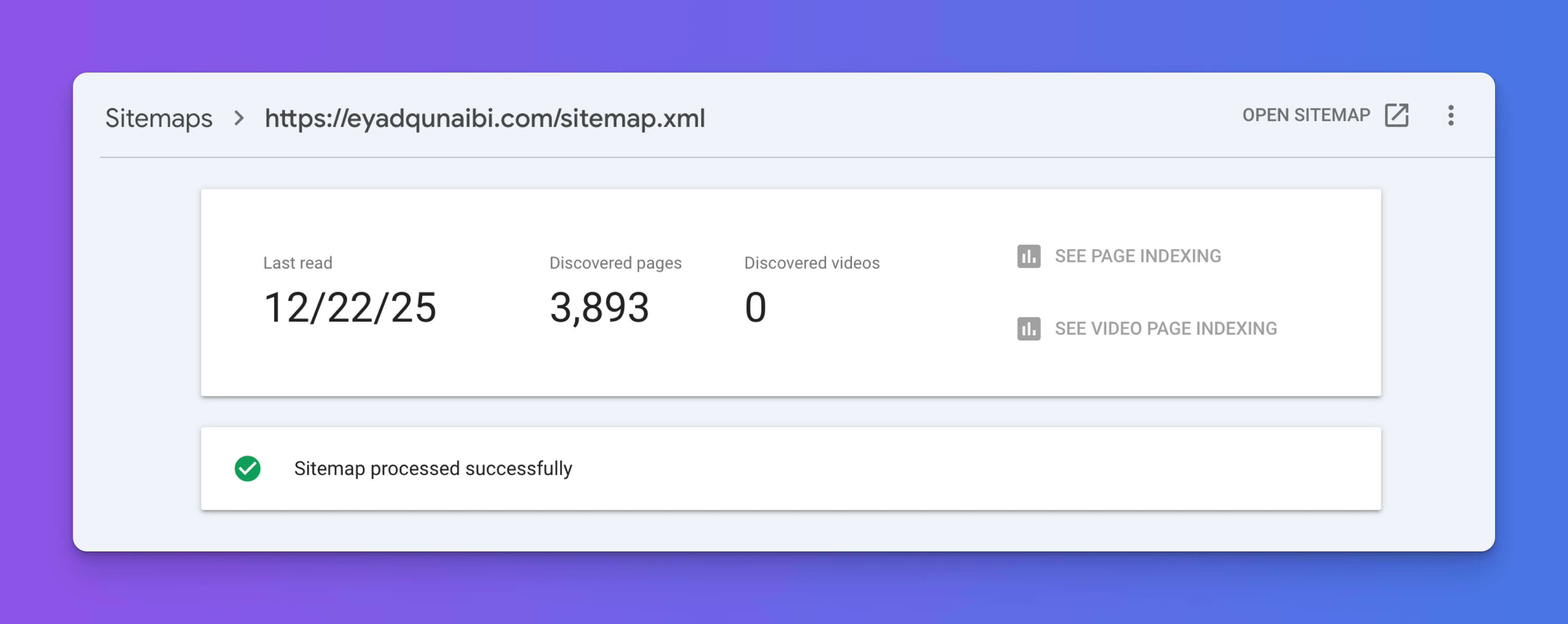
ok so it's been a few days since i submitted the new sitemap.xml via the Google Search Console.
Personal Transmissions
ok so it's been a few days since i submitted the new sitemap.xml via the Google Search Console.
we're finally live, but this is just the beginning..
Okay, so last time tried to translate all of the content from Arabic to English and French. I really wanted to get this working directly from inside Claude Code (using my Max subscription instead of paying for API usage), but whatever -- it didn't work.
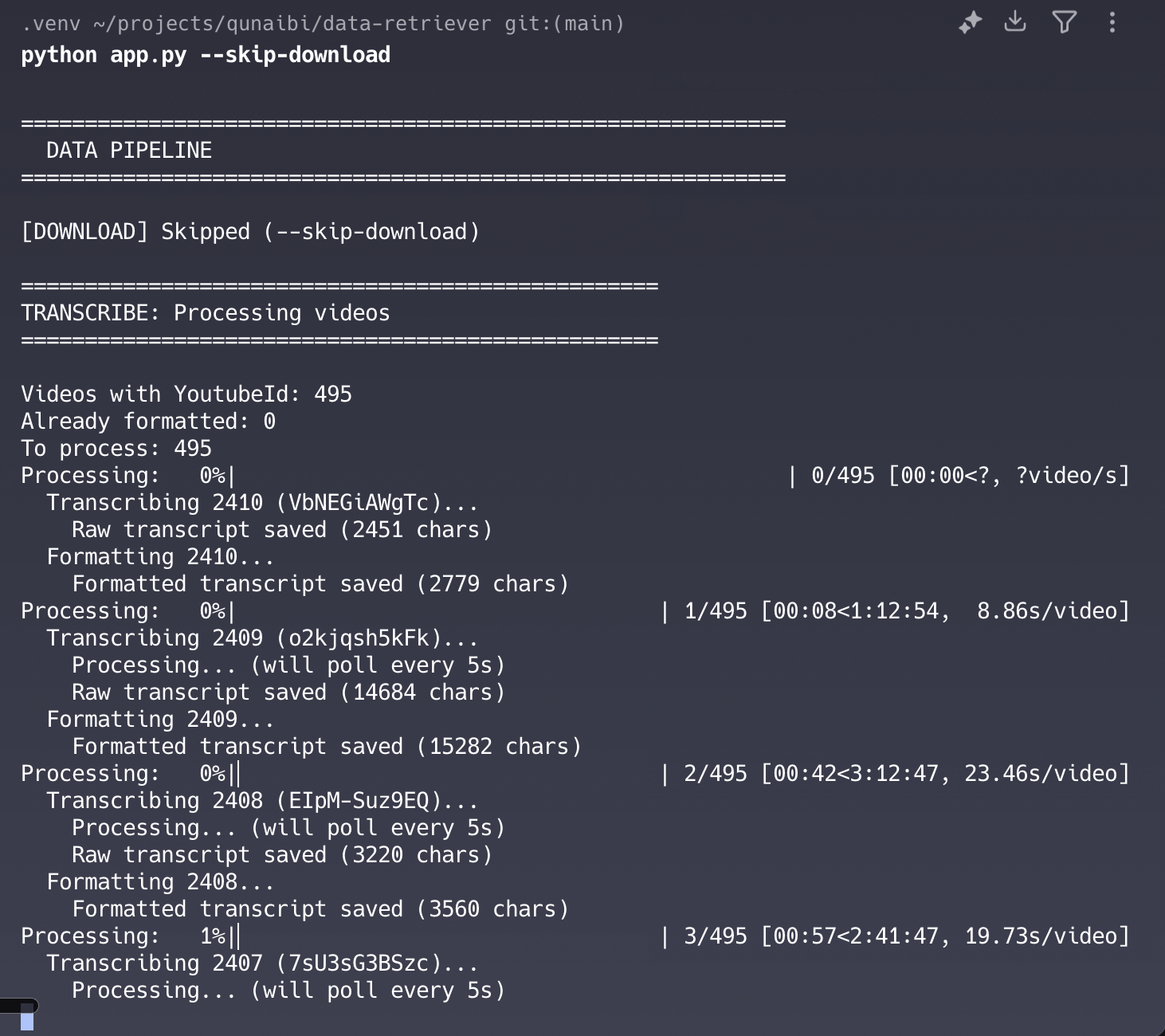
Today, we'll fire up a script and get the job done for shizzle.
I initially thought that I'd need to create some sort of custom workflow to get this done. But having recently upgraded to the $200/mo Max plan on Claude Code, I thought it worthwhile having claude take a stab at translating the .jsonl files directly.
I wasn't sure what to expect, since these files are BIG. I mean, the largest one clocked in at 4.5MB of pure text!
Came across this codepen which gave me an idea:
https://codepen.io/l3dlp/pen/PJyNdx
What if the whole thing was pixelated, like an indie game vibe?
Now working on a minimal UI where the main core screen shows the voxelated heart in the middle.
Ok, made it rotate about the y-axis. but didn't get any of hte mechanics sorted yet! i should do that next.
(wasted 30 mins so far doing this!)
So we're going to be updating the website at eyadqunaibi.com, and I'm using Claude Code with the front-end UI skill to do it.
I've been using this for a while now, and it's done a phenomenal job so far -- including with updating this very site! So I'll have it completely reimagine what the entire site is going to look like.
Ok so my original plan - way back when - was to create a completely new website that I can use to host the SEO optimized content in Q&A form, based on the terms that people search for.
Then, it occured to me.
Now that we've retrieved all the content, it's time to figure out how we can use that information to answer questions people are seeking answers to via Google.
Okay, the general idea here is that we're going to be converting all of the content that we have into text.
In my last entry, I shared that I'd finally managed to figure out the API powering the Eyad Qunaibi app. Today, I'll retrieve all the content, and save it locally.
We'll then figure out a way to use AI to map that to questions people are seeking answers to via Google, and then create those answers based on the entire corpus of materials. This'll be fun!
Ok this is getting ridiculous. It shouldn't be this hard getting the content from an app!
Alas, I'm close!
Ok, I still need to figure out how to get the content from the mobile app! This is such a big deal, because it'd just simplify everything downstream.
I mean, there's a mobile app that has access to 2,500+ pieces of content -- that i'd otherwise have to compile by hand. Why wouldn't I want to take advantage of that??
It's been a month since I last did anything about this series. I'm hoping I can be more consistent this time around!
In my last post, I was trying to figure out how to get the content from the mobile app.
I'd heard about ChatGPT releasing better memory and the ability to query past chats. I didn't think much of it at the time. Maybe this would be useful for looking up things I'd asked in the past and following up on them. But it was pretty vague, and I didn't have any deep thoughts on the matter.
Then I spotted a tweet. Someone asked ChatGPT to uncover what his top blind spots were. I thought, "Hey, let me try that!" I've had hundreds of conversations with ChatGPT over the past couple years, so there's probably something there.
I was completely floored by GPT's response. It was 100% on point. Many things I'd kind of felt on and off over the years but never quite articulated were right there in front of me - and ranked too!
I want to share them below and start a journey to improve each of the five points it highlighted. These are massive. If I can get better at these five things, I'll become so much more effective.
At the end of the day, there are certain things I'm good at and certain things I'm bad at. To become more well-rounded, you want to address the things you're absolutely bad at. Even if you just reach a competent level, that's enough of a boost to make you 10x more likely to succeed.
That's really what this post boils down to: uncovering all five blind spots, sharing my opinions on them, and later coming up with a plan to address each one.
Symptoms:
Blind Spot: You know marketing is crucial—but you undervalue its importance relative to product building. You treat it like a side task, even though it's the core engine of user growth.
Impact: You ship great products that barely see daylight. You're relying too much on organic reach or delayed launches, leading to lost momentum and weak customer traction.
Fix: Systematize it like you would engineering—timebox, templatize, and delegate. Or partner with someone who lives for attention.
Symptoms:
Blind Spot: You're optimizing for scalability and polish before proving the concept is wanted. You think like a craftsman, not a scrappy experimenter.
Impact: You miss fast validation loops. Ideas take weeks or months to test that could've taken days. When they flop, it's a heavy emotional and time cost.
Fix: Adopt a "10% solution" rule: build only what's necessary to test one core user behavior. Fight the urge to polish. Be ugly and fast.
Symptoms:
Blind Spot: You're delegating tasks but not outcomes. You want to trust people to self-manage but haven't built a system that guarantees visibility and follow-through.
Impact: You burn time reviewing others' work. You become the fallback for quality. Morale and performance stagnate on your team.
Fix: Set up weekly outcome-based reviews: not "did you do the task?" but "did the user outcome improve?" Use a single source of truth, kill passive tools, and implement weekly reporting with sharp, non-negotiable KPIs.
Symptoms:
Blind Spot: You see storytelling as indulgent or self-promotional. But your background, conviction, and faith alignment are major trust signals—especially in Muslim markets.
Impact: You're missing out on magnetizing early adopters and believers. You seem more like a tool than a movement.
Fix: Start weaving your story into everything: your landing pages, your video intros, your about page. Frame it as "why I had to build this" rather than "look at me."
Symptoms:
Blind Spot: You frame perfectionism as thoughtfulness. But often, it's fear of being wrong. You stall instead of launching the imperfect version and iterating.
Impact: It creates decision fatigue. You never feel like you're on solid ground, even when you are. Your velocity drops.
Fix: Set "imperfect by design" constraints—e.g., "launch within 72 hours or kill it." Keep a kill-switch journal for stalled ideas. Track decisions by speed, not just by quality.
Okay, let's take stock of where we're at.
Okay, let's see if we can find any other content sources for Eyad Qunaibi.
Okay, let's hit the first task on the list:
Okay, it's 8:30 p.m. I just set the timer for an hour. What am I going to do? I mean, it's kind of intimidating to think about what I could possibly do that could impact Gaza in any way. But I think it's helpful to just step back and think about the bigger picture.
Would I actually go to Gaza? The question haunts me. Not that I have the means right now, but what if I did? What if the borders were open, and the option was there? Part of me asks, 'Why wouldn't I?' Wouldn't I lay down my life to stop a child or a mother from being killed?
But would I actually? The best way to answer a hypothetical like this is to look at the track record. What have I really done for Gaza so far? That's the clearest indicator of what I might do if circumstances allowed.
Maybe I'm approaching this wrong. The question isn't necessarily about physically going there—it's about what part of my life I'm willing to give to this cause.
Our time is our life. It's the most valuable, non-renewable resource we possess. So perhaps the real question is: what portion of my life am I willing to dedicate to Gaza?
When viewed this way, dedicating structured time becomes a tangible form of giving a piece of my life away. Not all at once; but consistently and meaningfully.
So I'm starting here: dedicating one hour of each weekday to Gaza.
Carve it out. Protect it. Make it sacred.
I don't know exactly what I'll do in that time or the impact it might have, but it's a concrete piece of my life I'm committing. A smaller version of "going to Gaza" that I can actually fulfill right now.
Hopefully, it's something I can build on.
Muslims, do not make your question: 'Will this or that change in my life stop what is happening in Gaza?' Rather, let your question be: 'Have I offered through it what I can and proven that I want to support Islam and its people?'

ما يحدث يلين الحجر...قصف مراكز الإيواء والخيام المهترئة، حرق المراكز الطبية بمن فيها، المزيد من الناس في العراء بلا مأوى ولا طعام ولا علاج. كم نحن خاسرون إذا مرت الأيام على مجازر غزة ونحن عاجزون -لا عن نصرة إخواننا فحسب- بل وعن أن نوظف هذه الأحداث لتُحدث ثورة في تفكيرنا وسلوكنا
Most people search for domain names the wrong way. They start with an idea generator, check domain availability, and when their perfect .com is taken, they either:
I've found a better way.
There's a better approach. Every day, tens of thousands of domains expire and get dropped because:
While many dropped domains are worthless, some are gems. Finding them is like finding a needle in a haystack, but the advantages are significant:
The main challenge is filtering through thousands of domains. Some domain connoisseurs spend hours daily reviewing domain lists - I'm not one of those people.
Here's the strategy I developed:
Take all available dropped domains
Apply basic filters:
.com)Feed the filtered list (still thousands) into an LLM with specific criteria like:
Get notified when domains matching your criteria become available
Here's a killer strategy that's often overlooked: searching for domains that transliterate to Arabic words. I've previously sold shoghol.com for $1,500 using this approach.
Recent catches using this filter, all at basic registration price ($13):
istighfar.com - means "seeking forgiveness" in Arabicmroor.com - means "traffic" in Arabicwkala.com - means "delegation" in Arabicghoroob.com = means "sunset" in ArabicI've packaged this entire system into a service that lets you enter your own filters and get notified when domains matching your criteria become available. It's already helped me snag these and many other great domains for dirt cheap.
Note: I'll update this post with example domains once I have permission to share them.
I have a long list of ideas for things that I want to work on. A list that I will hopefully share at some point. But the core idea is that the best way to work through a list of ideas would have been to dedicate a solid chunk of time to actually implementing it. They become bigger events, there's a certain amount of work that needs to be done. That's typically a matter of days, weeks, possibly even months depending on the size of the project.
So it needs to clear a high bar before it can get my attention. And a lot of ideas just fall at the bar or even below and so they don't really pass they just stay lingering in a to do list that just keeps growing with time.
But now with AI and you know the availability of tools like Cursor and Lovable and others it's actually become a lot easier to build and launch projects and test them to see if they actually work. And of course this puts pressure on distribution for you to figure out like how you're actually going to grow a tool and that's something I'm still trying to figure out but we'll get to that later.
I'm going to be doing a bunch of experiments with distribution to figure out like how to do that effectively but right now the sort of focus for the first half of this year is how do we get more stuff done? How do you publish more?
On February 2nd, I woke up to my highest weight ever: 85.1 kilograms. Something clicked. Instead of setting a grand goal, I remembered advice from "Mini Habits" and "Atomic Habits" - start with tiny, daily habits that are impossible to fail.
i'm currently 85kg, the heaviest i've ever been. i'd like to drop 10kg in the next 3 months. starting this thread to track my weekly progress. i'll be asking myself 1 simple question, each day: "did i feel hungry today" yes = ✅ no =❌
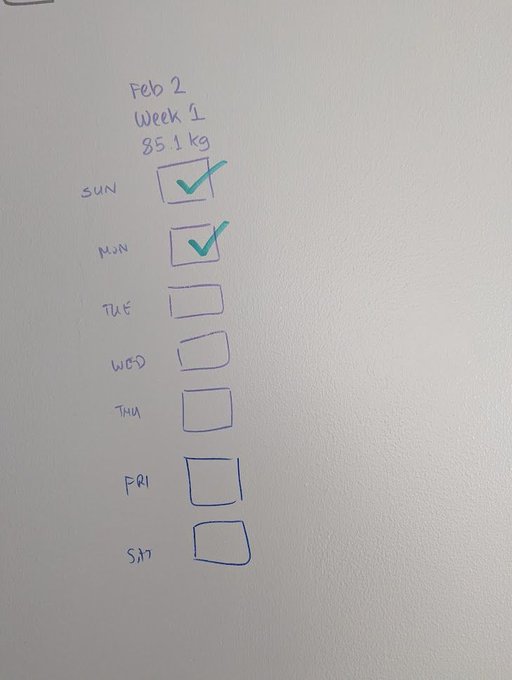
I chose one simple question: "Was I hungry today?"
That's it. No diet plans. No calorie counting. Just checking if I felt genuine hunger at any point during the day.
Nine weeks in, I've lost nine kilograms - exceeding my initial expectations. But the real win isn't the weight loss. It's the fundamental shift in how I relate to food.
Before, hunger was an annoyance to silence immediately. Now, feeling hungry feels like winning. My baseline has shifted - I aim to maintain a slight hunger throughout the day rather than constantly feeling full.
Take ice cream: I used to eat two or three a day without thinking. I'd just eat them, feel a momentary sense of relief, and then go back to some sort of baseline. Now I have one in my fridge for two and a half weeks, untouched. Not because I'm resisting temptation, but because I don't crave it anymore. My satisfaction comes from feeling light and slightly hungry.
This attempt feels fundamentally different from my previous weight loss attempts. Before, I was always working towards a goal - a number on the scale or a deadline. Once I hit that goal, I'd inevitably bounce back to my old habits. But this time, I'm not working towards an endpoint. I've changed my relationship with food itself.
The key difference is that I'm not resisting temptation or forcing myself to change. Instead, I've rewired what gives me satisfaction. Feeling slightly hungry throughout the day has become my new normal, and it feels good. I don't see this as a temporary state to endure until I hit some target weight - it's just how I live now.
This experience made me wonder: what other improvements could I make by focusing on systems rather than goals? As Scott Adams puts it in "How to Fail at Almost Everything and Still Win Big": "If you do something every day, it's a system. If you're waiting to achieve it someday in the future, it's a goal."
Now that I've established this new relationship with food, I'm curious about applying the same systems-based approach to building muscle. Instead of setting ambitious lifting goals or following complex workout plans, I'm starting with one simple question: "Did I train one muscle group to failure today?"
I'll report back in a few months on how this experiment goes. But if the weight loss journey taught me anything, it's that the key isn't in the grand plans - it's in the tiny, daily habits that reshape how you think about the whole endeavor.
Take off your snowshoes
Every few days I come across people on the same trails trudging slowly with snowshoes and hiking poles. They’re going 3x slower than they would with sneakers, and 2x slower than they would with winter boots. [...]
We need to have a nuanced understanding of the world to understand when the situation calls for a specialized tool.
Having been in fintech for a while, I've noticed something in common between the many new startups that come and go. They all require access to personal information.
A specific example that comes to mind is the Plaid-like solution we developed while working on amal. We'd ask customers for their bank credentials[ajy] and then proceed to login on their behalf in order to share the resulting account information with the 3rd party application they are using (e.g. for transferring money, tracking their spending, etc).
Optionality's one of those things you don't really think about. People don't generally wake up one morning thinking "Why, it appears I've spent the past several decades of my life optimizing for optionality. Perhaps I should figure out why?".
Most don't even recognize the term -- until it's already explained to us. If you're one of those people, this could well be the most important posts you read this year.
Been having a hard time lately focusing.
It's like whenever I start doing anything of any significance I get derailed, and fall into this spiral of thought where I reconsider whether what I'm about to do matters, why it would, and whether I could be doing something else that would be more "productive". The end result is that I end up doing nothing (no, the irony is not lost on me).
It used to be that you needed to know Kotlin and Swift to develop apps for both Android and iOS, but those days are long gone.
Even the fundamental reasons for doing so have changed — some sort of compromise between performance and speed to deployment. React Native apps were kinda slower than native apps by a smidge, but with the introduction of Flutter — that difference was wiped out almost entirely. With Flutter, you get native app performance because you leave HTML and JS behind.
Yes, that's right. The best bank in Bahrain is … Meem. This nomination will be especially shocking to those of you that read my last post that ripped the Meem app to shreds.
I was recently working on a way to serialize and deserialize a Faraday connection that uses HTTP::CookieJar to manage persistent cookies across requests.
I needed to do this because I wanted a way to "freeze" an HTTP connection instance, and later "thaw" it to resume the operation — without consuming a ton of space in memory.
At Amal, we have an AI chat bot that works over WhatsApp — allowing our customers to speak to their bank account, asking questions like "What's my balance" and "How much have I spent on Uber's this month?".
A problem we faced really early on when connecting to WhatsApp was that when a user started a conversation with our bot on WhatsApp, we had no idea where they came from!
If you're a "digital only" bank like Meem, the app your customers use is all they see: it's like a virtual 🏦 branch.
That's fitting, because you know what my impression of meem is as a user? When I open up their app, it feels like walking into a crowded butcher shop, with soaking wet floors leaving soily footprints amongst the carcasses dripping in blood and a lurking stench of cow excrement surrounded by the constant buzzing of flies swarming overhead. Customer "service" is dispensed from behind a large chopping board with gizzards of meat feeding the hungry flies where your elbows sit.
👉 If you haven't read Part 1, do that first.
In the last post, I discussed the question of access to capital and why's important to verify that we do in fact have a problem before we attempt to "solve" it.
Today, I was on a panel discussing lending and access to capital (~~not a wooden panel, mind you — but a panel of speakers~~. Now that I think about it, we may have been sitting on wooden panel flooring).
At any rate, the discussion covered alot of ground, all as part of the larger context of fixing the "access to capital problem" for SMEs (Small & Medium sized enterprises) in Bahrain.
TLDR: Use the tool at the bottom of this page 👇
I use Google Forms ALOT! On a normal day, I'm looking at 10 — 15 submissions to the same two forms: a personal expense tracking form, and a company expense tracking form.
In this post, I'll discuss how I invest my money - even small amounts - so I can stand a reasonable chance of attaining an average return (of roughly 7%/year).
The keyword here is how.
I’ve been working with Files, Blobs and DataURIs recently, and have found the whole thing just very confusing. What is the difference between the three, and how do the various methods around them work (createObjectURL, readAsDataURL and the various FileReader methods).
Because it's not just one topic that I can StackOverflow my way out of, I decided to step back and try and piece together the different parts into a coherent model. That's what this post is about…
This is the first in a series of examples where I explain how you can use the solving problem method I described earlier.
You're walking through a local supermarket pushing a cart full of your weekly shopping supplies and bump into your old friend Adam, who you haven't seen since college.
A decade ago, I worked at General Electric. GE is a huge company (300k+ employees) that operated in a myriad of fields from banking to media, to the field I was involved in: Energy.
I spent 2 of my 5 years at GE working as a Six Sigma Black Belt, two years that changed my life. That's because during that time, I picked up a problem solving technique that completely changed everything I knew about the topic. Problem solving is one of those things you don't really think about much. When someone faces a problem, they tend to search for a solution to that specific issue. Rarely, if ever, do we step back to consider the problem solving approach in the abstract i.e. whether the approach we follow to solve problems is working, and whether it requires tweaking to achieve better results.
Some people think that focus is the result or inherent perseverence, or the result of "passion" or some innate quality. I believe it's the result of success. It's much easier to focus on something, and persevere, when it's working.
In the context of a lean startup, if you don't encounter early signs of success, then it's often best to give up and move on to the next thing.
This is not a well-defined idea, and I still don't know what to test — or indeed, whether there's anything to do here. I do know that people in Bahrain buy & sell real-estate the same way they have in the pre-web era. The only difference is that now there's a bunch of websites (really, not very different than catalogs, or newspaper classifieds) that advertise properties. The transaction is always initiated via a phone call, followed by a site visit.
There's certainly room for improvement — but before doing anything, the first step has to be about discovery. Don't try to fix something you don't fully understand.
The GForms's Landing page took me about 10 days to build, launch and validate — most of it spent on the damn front-end making sure everything looked OK on mobile and desktop. Once I ran the experiment, within 24 hours I knew it was not going to fly. The question is, could I have finished it sooner?
You bet.
Note: I actually ran this experiment about 2 weeks before I posted this, but wanted to document everything here — hence this post
Alright, let's hit another idea and see what we can learn. This one goes like so:
The first idea I'll be testing is one that I've had for a while. The description I had from the Ideas list is this:
The way that large companies propagate high-level goals down from leadership to employees across the company is broken. It ends up becoming a formality, done over Powerpoint slides twice a year (beginning and end, during performance reviews). This is a lost opportunity, one where goals could serve as the glue that ties employees daily work towards a greater company objective. Coupled with transparency, employees can see exactly how they impact the greater goals.
Finding something to work on can be daunting. When you choose to work on something, you're also choosing not to work on countless other things. The FOMO beast in me wreaks havoc at the mere mention of such a quandary.
So what do I do? How can I take a decision — the right decision — at a time when there are so many things going on in so many different fields. For a split second, I want to dive into all of them: Biotechnology, Nutrition, Self-driving cars, Machine Learning, Nanotechnology, Bitcoin, Drones and so many more! There's so much to learn, and so little time! (It doesn't help that I'm addicted to learning, and enjoy it immensely — even for it's own sake).
I'm writing this on the plane back from Istanbul to Bahrain. I've got an excruciating ear infection of sorts that's driving me absolutely mad, ebbing between being slightly annoying and utterly unbearable.
Thinking about how we set priorities, I can't help but reflect on how life is so self-centered, and how the needs of a person shift so suddenly from long to short-term thinking in the wake of an existential (or near existential) risk to their life.
Hola there,
I've been spending some time lately thinking about things on a grander scale, trying to understand where we are today .. and where we might be headed. This is nothing new .. I often take whimsical thought-trips, stepping away from the laptop, lying down on my back and just staring at the (bland, nondescript) ceiling.

I've spent alot of time trying to figure out what my goals from life are, and these thoughts inevitably lead to the question of purpose:
We've all seen it: front page headlines of "visionaries" gazing into the abyss .. every sentence attesting to the incredible success that he/she's been able to conjure in the face adversity.
Last year, someone came up to me and asked: Do Bahraini's buy stuff online?
"Of course they do!", I said, without a moments hesitation. "Just look at .."